
Welcome to week two of our 12-week "Small Business Finance and CIS Compliance Essentials" series! Last week, we took a deep dive into Gross Payment Status (GPS) and why it’s the "golden ticket" for subcontractors in the construction industry. If you missed it, you can catch up on our blog page.
Today, we’re getting down into the nitty-gritty of the day-to-day: the books.
Let’s be honest for a second. Most people don’t start a plumbing business, a carpentry firm, or a consultancy because they have a burning passion for spreadsheets and bank reconciliations. You started your business because you’re great at what you do. Bookkeeping is usually that "Sunday night job" that sits on the corner of the dining table, looming over you while you’re trying to enjoy your roast dinner.
Because it’s often done in a hurry or when you’re exhausted, mistakes happen. And in the eyes of HMRC, a "simple mistake" can sometimes lead to a complicated headache. The good news? Most of these errors are incredibly common and, more importantly, completely fixable.
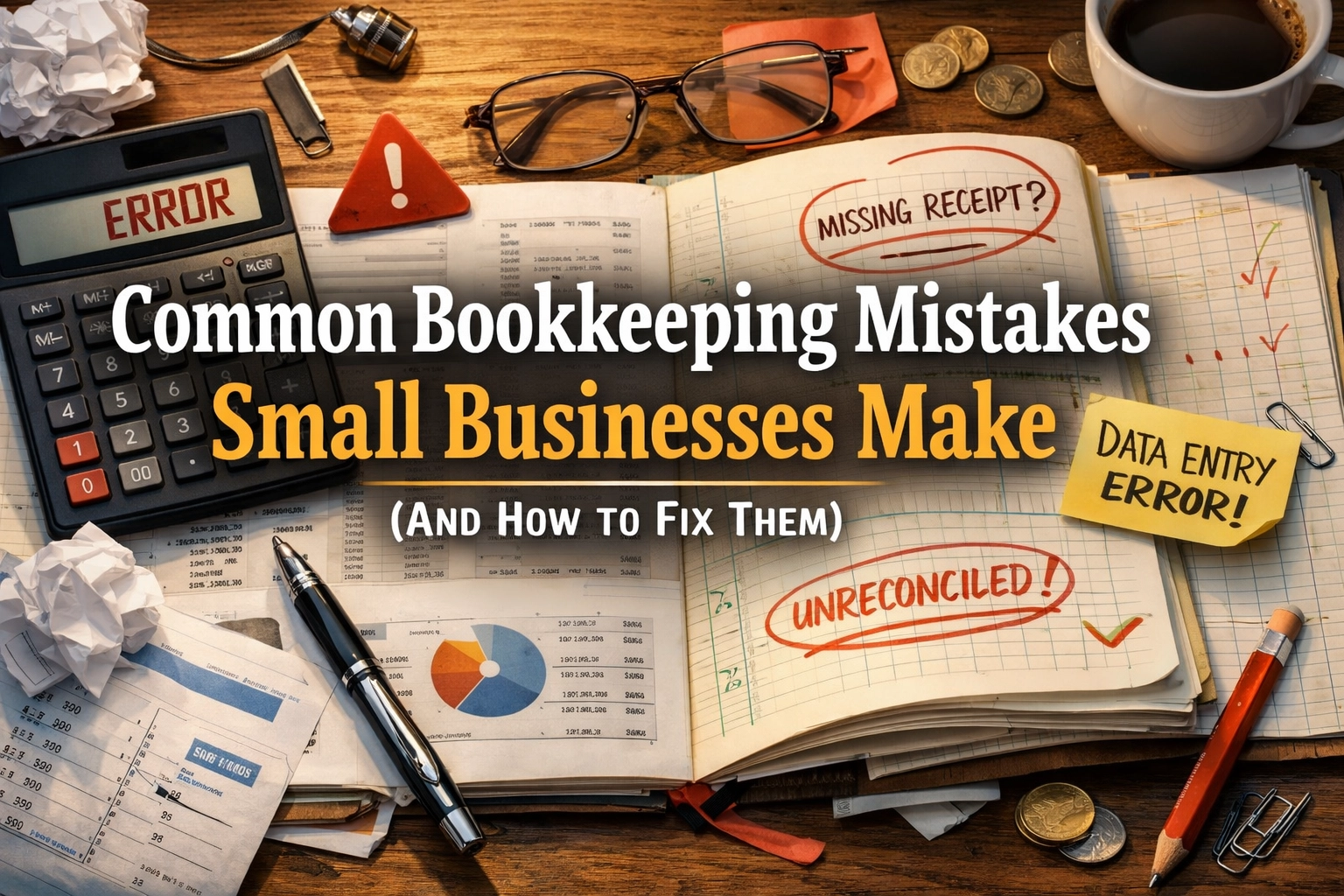
Here are the most common bookkeeping mistakes we see at SBS Essex Ltd and, more importantly, how you can steer clear of them.
1. The "One Big Pot" Syndrome (Mixing Personal and Business)
This is easily the number one mistake small business owners make. You’re at the petrol station, you realise you’ve left your business card in your other trousers, so you tap your personal card. Or, you’re at Screwfix picking up supplies and decide to grab a few bits for a DIY project at home on the same transaction.
It seems harmless, but mixing your finances creates a "muddle" that is a nightmare to untangle at year-end.
The Fix: Keep them strictly separate. Open a dedicated business bank account and use it for everything business-related. If you accidentally use the wrong card, make a note of it immediately and move the money across to "reimburse" yourself properly. This makes your bank reconciliation much cleaner and ensures you aren't accidentally claiming for your weekly Tesco shop as a business expense.

2. The Infamous "Shoebox" Method (Missing Receipts)
We’ve all seen it (or lived it): a van dashboard covered in faded thermal paper receipts, or a shoebox stuffed with crumpled invoices. The problem with physical receipts is that they fade, they get lost, or they get covered in coffee.
If you don't have a receipt, you generally can't claim the VAT back, and you can't deduct it as an expense against your profits. If you lose a receipt for a £600 piece of kit, that’s £100 in VAT you’ve just thrown away. Over a year, those "little" lost receipts can cost you thousands in overpaid tax.
The Fix: Go digital. Whether you use Xero, QuickBooks, or Sage, they all have brilliant mobile apps. Take a photo of the receipt the second you get it, and then you can bin the paper version (within HMRC guidelines). It’s stored in the cloud, it’s legible, and it’s ready for your bookkeeper to process.
3. Playing "Catch-Up" (Late Reconciliations)
Bank reconciliation is just a fancy way of saying "making sure your bank balance matches what your software says." A lot of business owners leave this until the end of the quarter or, worse, the end of the financial year.
By the time you sit down to do it six months later, you’ll see a transaction for £42.50 and have absolutely no idea what it was for. Was it a tool? Was it a parking fine? Was it a refund?
The Fix: Little and often. Aim to reconcile your bank once a week. It takes ten minutes on a Friday afternoon but saves you ten hours of stress in April. If you use automated bank feeds in software like Xero or QuickBooks, most of the work is done for you: you just need to "match" the transactions.
4. The "Miscellaneous" Black Hole
When you aren't sure where to put an expense, it’s tempting to just chuck it into a category called "General Expenses," "Sundries," or "Miscellaneous."
While this gets the job done in the short term, it makes your financial reports useless. If you look at your Profit and Loss report at the end of the month and see £2,000 under "Miscellaneous," you have no idea where your money is actually going. Are you spending too much on materials? Is your van insurance too high? You won't know if the data is hidden.
The Fix: Keep your Chart of Accounts lean but specific. If you're a contractor, have clear categories for "Materials," "Subcontractor Costs," "Tool Hire," and "Fuel." This allows us to give you a clear picture of your business health.

5. Forgetting About the CIS (Construction Industry Scheme)
For our construction clients, this is a big one. If you’re a contractor and you fail to verify a subbie, or you apply the wrong deduction rate (20% vs 30% vs Gross), you are personally liable for the difference.
HMRC doesn't take "I forgot" as a valid excuse. Late CIS returns also carry an immediate £100 penalty, which can escalate quickly. If you want to stay on the right side of the taxman, keeping your CIS records updated is non-negotiable. Check out our guide on how to master CIS compliance for more details.
The Fix: Automate your CIS. Modern accounting software can handle CIS deductions automatically once you’ve set up the subcontractor correctly. It calculates the deduction, tracks the materials, and can even file the monthly return for you.
6. Not Reviewing Your Numbers Monthly
If you only look at your books when your accountant asks for them once a year, you are flying your business blind. You might feel like you have plenty of cash in the bank, but if you haven't accounted for the VAT you owe or the corporation tax bill lurking around the corner, that cash isn't really "yours."
The Fix: Set a date with your dashboard. Every month, look at your Profit and Loss statement and your Balance Sheet. Are you making as much profit as you thought? Who owes you money? (Accounts Receivable management is key to cash flow!).

7. DIY-ing When You Should Be Delegating
The biggest mistake of all is thinking you have to do it all yourself. As your business grows, your time becomes more valuable. If you’re spending five hours a week struggling with Sage or Xero, that’s five hours you aren't on-site earning money or with your family.
Manual data entry is also prone to "fat-finger" errors: typing £1,000 instead of £100 can throw your entire year out of whack.
The Fix: Work with a professional. At SBS Essex Ltd, we are AAT licensed and experts in Sage, Xero, and QuickBooks. We don't just "do the books"; we make sure they are accurate, compliant, and useful for your business growth. We can spot errors before they become penalties and ensure you’re claiming every single penny you’re entitled to.
How SBS Essex Ltd Can Help
Bookkeeping shouldn't be a source of stress. It should be the tool that gives you the confidence to grow your business, take on that new project, or finally hire that extra pair of hands.
Whether you’ve got a mountain of receipts that need sorting or you just want someone to take over the weekly reconciliation and CIS returns, we’re here to help. We speak "trade," we understand the construction sector, and we promise not to bore you with too much jargon.
Ready to get your books in order?
If you’re worried about any of the mistakes mentioned above, or if you’ve realised your current system involves more guesswork than groundwork, let’s have a chat.
We offer a Free Discovery Consultation where we can look at your current setup, see where the "muddles" are, and figure out a plan to get you back on track.
Click here to book your Free Discovery Consultation today!
Next week in our series, we’ll be discussing outsourced payroll: specifically, do you really need a provider, or is it something you can keep in-house? See you then!