
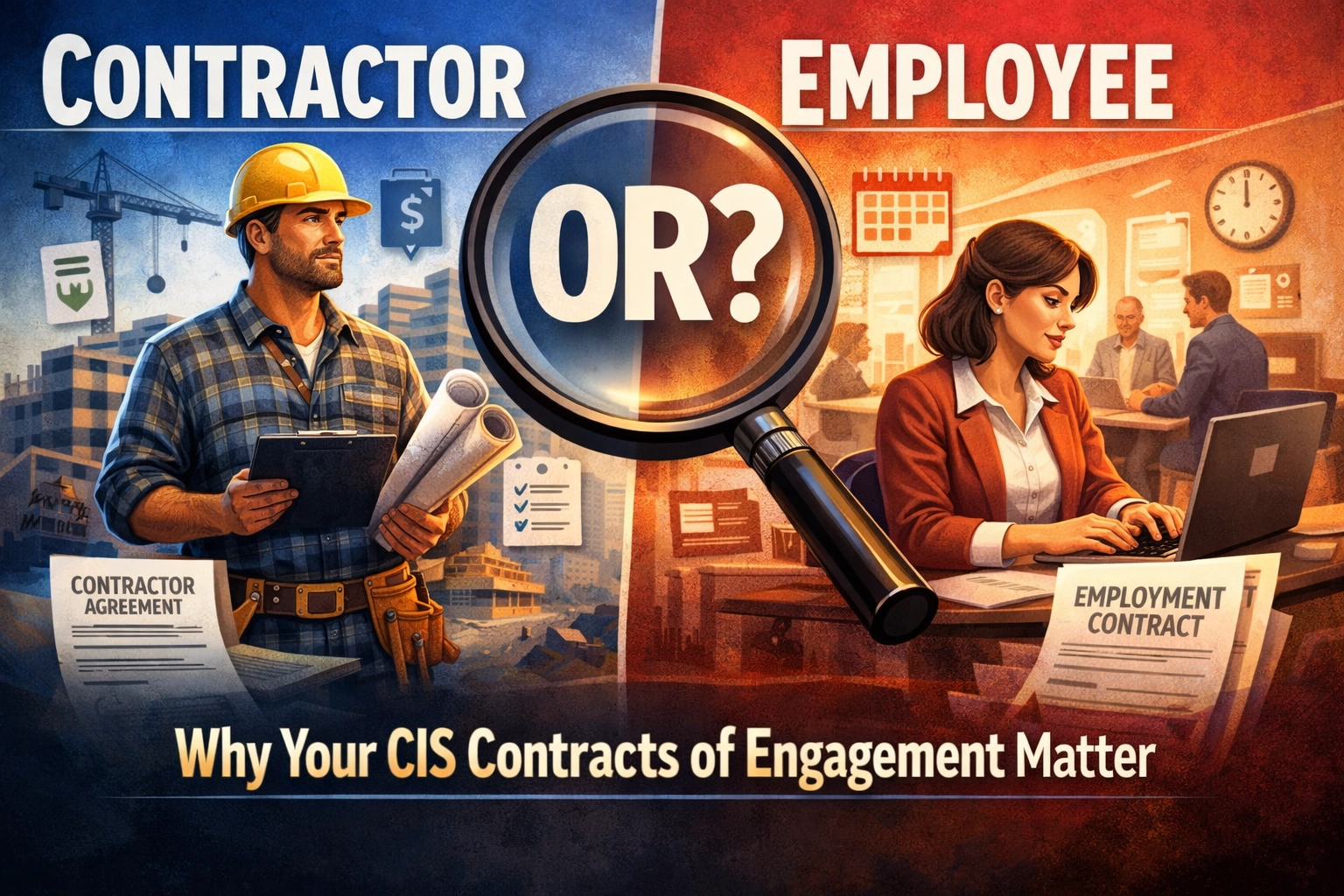
If you’ve been in the construction industry for a while, you know that the line between a "subbie" and a permanent member of staff can sometimes get a bit blurry. You’ve got guys who have been on your sites for years; they know how you take your tea, they’ve got their own set of keys to the unit, and they’re as much a part of the furniture as the van itself.
But here’s the thing: just because someone feels like one of the team doesn't mean HMRC sees them that way.
In the eyes of the taxman, there is a massive legal and financial difference between a bona fide sub-contractor and a "deemed employee." If you get this wrong, the consequences aren’t just a bit of extra paperwork: it’s a potential financial nightmare of back-dated National Insurance contributions, unpaid holiday pay, and hefty fines.
At SBS Essex Ltd, we see this all the time. As an AAT Licenced Bookkeeping Practitioner, we don't just crunch the numbers; we help small businesses stay on the right side of the law. Today, for Week 10 of our series, we’re diving into why you absolutely must have a Contract of Engagement for every sub-contractor you hire.
The "Deemed Employee" Trap
Let’s start with the basics. Why does HMRC care?
When you hire a sub-contractor under the Construction Industry Scheme (CIS), they are responsible for their own taxes (minus what you deduct at source) and they don’t get employee benefits like sick pay or pensions. This makes them "cheaper" and more flexible for your business.
However, if HMRC decides that a worker is actually an employee in disguise: meaning they work solely for you, use your tools, follow your exact schedule, and have no financial risk: they will reclassify them.
This is often referred to as the "IR35 trap" or "employment status misclassification." If this happens, you (the employer) are usually the one left holding the bill for years of unpaid Employer’s National Insurance and other benefits.

What is a Contract of Engagement?
A Contract of Engagement is a formal document that outlines the relationship between your business and the sub-contractor. It’s not an employment contract. Instead, it’s a business-to-business agreement.
Think of it as your "insurance policy" against an HMRC enquiry. It proves that both parties intended for the relationship to be one of independent contracting, not employment.
Without a written contract, you are relying on "verbal agreements" and "how we’ve always done it." In a legal dispute or an audit, that holds about as much water as a sieve. A written contract sets the ground rules and provides the evidence you need to show that your subbies are truly independent.
The Three Pillars of Contractor Status
When HMRC looks at your relationship with a sub-contractor, they look at three main areas. Your Contract of Engagement needs to address these clearly:
1. Supervision, Direction, and Control (SDC)
This is the big one. If you tell a subbie what to do, where to do it, and exactly how to do it, they look an awful lot like an employee.
- A Contractor: Is hired to achieve a result (e.g., "Wire this house to these specs"). They use their own expertise to decide how to get it done.
- An Employee: Is told exactly how to work throughout the day and is supervised at every step.
2. Right of Substitution
This is often the "silver bullet" for proving someone is a contractor. A true sub-contractor should have the right to send someone else in their place to do the job. If John is sick, can he send his mate Dave (provided Dave is qualified) to finish the tiling? If the contract allows for substitution, it’s very hard for HMRC to claim John is an employee.
3. Financial Risk
Does the worker stand to lose money if they mess up? An employee gets paid for their hours regardless. A sub-contractor should be responsible for fixing their own mistakes on their own time and at their own cost. They should also provide their own significant equipment and insurance.

Why a Handshake Isn't Enough Anymore
We get it. In the construction world, a man’s word used to be his bond. You shake hands, you agree on a day rate, and the job gets done. But the modern tax landscape doesn't care about handshakes.
HMRC has become increasingly aggressive in targeting the construction sector. They know that many firms use sub-contractors to avoid the "on-costs" of employment. By having a robust Contract of Engagement, you are telling HMRC: "We have done our due diligence. We have assessed this relationship, and it is legally a sub-contracting arrangement."
The Benefits of Getting It Right
Aside from staying out of "Tax Prison," there are genuine business benefits to using proper contracts:
- Clarity on Deadlines: You can specify exactly when the work needs to be completed and what happens if it isn't.
- Payment Terms: No more "When am I getting paid, boss?" The contract clearly states the payment cycle and the CIS deduction rates.
- Intellectual Property and Liability: Who owns the designs? Who is liable if a pipe bursts six months later? The contract settles this before it becomes a headache.
- Professionalism: It shows your subbies (and your clients) that SBS Essex Ltd runs a tight ship.

How SBS Essex Ltd Supports Your Compliance
Managing CIS is more than just submitting a monthly return to HMRC. It’s about ensuring that every piece of the puzzle: from the first day a subbie walks onto the site to the final payment: is handled correctly.
As an AAT Licenced Bookkeeping Practitioner, we provide specialised bookkeeping services for small business owners in the construction trade. We can help you:
- Verify Sub-contractors: Making sure you’re deducting the right amount (0%, 20%, or 30%).
- Status Reviews: Helping you look at your workforce to see who might be at risk of being "deemed an employee."
- Record Keeping: Maintaining the digital trail that HMRC expects to see during an inspection.
- CIS Returns: Ensuring your monthly filings are accurate and submitted on time so you avoid those nasty £100+ automated penalties.
We aren't just here to balance your books; we are here to protect your business. We know the local Essex trade scene, and we know exactly what HMRC is looking for when they come knocking.
Don't Wait for the Audit
The worst time to realize you need a Contract of Engagement is when HMRC is already sitting in your office asking for your records.
Take the time this week to look at your "regulars." If you have sub-contractors who have been with you for months or years without a formal agreement, it’s time to fix that. It doesn't have to be a 50-page document full of "wherefores" and "heretofores." It just needs to be a clear, concise agreement that reflects the reality of the working relationship.

Final Thoughts
Your business is your livelihood. You’ve worked too hard building your reputation and your bank balance to let a "status dispute" take it all away. By implementing Contracts of Engagement, you’re not being "bureaucratic": you’re being smart. You’re protecting your cash flow, your peace of mind, and the future of your company.
If you’re feeling a bit overwhelmed by the technicalities of CIS compliance, don't worry. That’s what we’re here for. Whether you need help setting up your CIS systems or you’re looking for comprehensive bookkeeping services for small business, SBS Essex Ltd has your back.
Ready to get your CIS compliance in order? Give us a shout today, and let’s make sure your business is as solid as the houses you build.
Check back next week as we continue our 'Small Business Finance and CIS Compliance Essentials' series, where we’ll be discussing how to handle VAT on top of your CIS obligations without losing your mind!