Hello everyone! Claire Murphy here. If you’re reading this, it means we’ve officially survived the April 2026 tax madness. Take a deep breath, the spreadsheets have stopped spinning (mostly), and we can finally look at some of the actually good news that came out of the recent updates.
Now, usually, when I talk about HMRC and "updates," people start looking for the nearest exit or bracing their bank accounts for impact. But hold onto your hats, because this time, they’ve actually thrown small business owners a bit of a bone.
As of April 6th, 2026, there’s a lovely little rule change regarding how we handle eye tests and flu vaccinations for our teams. It might sound like small fry compared to Corporation Tax or VAT, but in the world of bookkeeping services for small business, we know that the small wins add up to big savings.
Let’s dive into why this matters, how it works, and why you should probably be the "office hero" by shouting about it.
The "Old" Way vs. The "New" Way
Before we got to this glorious May of 2026, the rules around these health perks were a bit… well, clunky.
In the "Before Times," if an employer wanted to provide an eye test or a flu jab tax-free, they generally had to arrange and pay for it directly. This meant setting up corporate accounts with opticians or booking a private nurse to come to the office. If an employee went out, paid for it themselves, and then asked for the money back, HMRC looked at that reimbursement as "earnings." That meant it was subject to Income Tax and National Insurance.
Essentially, the paperwork was often more painful than the flu jab itself.
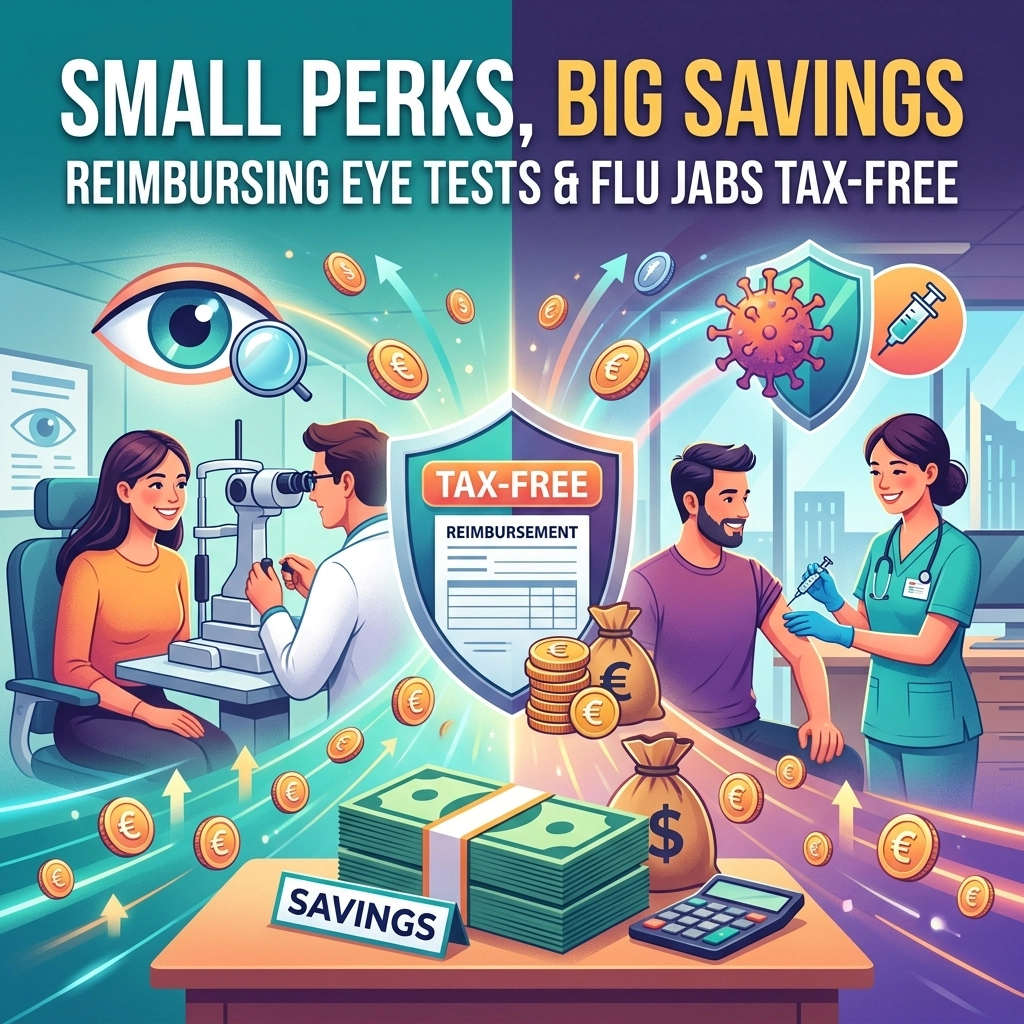
But as of April 6th, 2026, the game has changed. HMRC has finally acknowledged that we live in a modern world where people like flexibility. Now, if your employee pays for an eye test or a flu vaccination and you reimburse them, it is treated as tax-free. No Benefit in Kind (BiK) forms, no extra NI contributions, just a straightforward "thank you" to your staff.

Why Eye Tests are a Sight for Sore Eyes (Pun Intended)
If you’re running a construction firm or a trade business, you might think, "Claire, my guys aren't staring at Excel all day, why do I care about eye tests?"
Well, safety first! Whether your team is operating heavy machinery, reading blueprints, or just driving the van between jobs, clear vision is a non-negotiable.
Under the Health and Safety (Display Screen Equipment) Regulations, you’ve actually been required to provide eye tests for "VDU users" (anyone using a computer/screen for a significant part of their day) for a long time. But now, even for those who aren’t stuck behind a desk, being able to offer a tax-free reimbursement for an eye test is a brilliant "wellness" perk.
It shows you care about their health beyond just the hours they’re on the clock. Plus, if they need glasses specifically for VDU work, you can often provide those tax-free too. It’s a win-win: they see better, you look better as a boss, and the taxman stays out of the transaction.
The Flu Jab: Keeping the "Man-Flu" at Bay
We’ve all been there. One person comes into the office or onto the site with a "little sniffle," and within three days, half your workforce is down for the count. For a small business, having two or three people off sick at once isn't just an inconvenience; it’s a productivity disaster.
Previously, if you wanted to encourage your staff to get a flu jab, you had to jump through those "direct provision" hoops I mentioned earlier. Now, you can simply tell your team: "Go down to the local pharmacy, get your jab, bring me the receipt, and I’ll pay you back."
By reimbursing that £15–£20, you’re potentially saving thousands in lost hours and project delays. And because it’s now officially tax-free, it doesn't add a penny to your payroll tax liability. It’s a cheap insurance policy for your business continuity.

How This Saves You Money (The Bookkeeping Bit)
I know, I know: I’m a bookkeeper, I can’t help but talk about the numbers.
When a benefit is "tax-free," it doesn’t just mean the employee gets the full amount. It means the employer (that’s you!) doesn't have to pay Class 1A National Insurance on that "benefit."
Let’s say you have 10 employees. Each gets an eye test (£25) and a flu jab (£15). That’s £40 per person, or £400 total.
- Under the old rules (via reimbursement): That £400 would have been treated like a bonus. You’d pay Employer’s NI on top, and the employee would see a chunk of it disappear in their tax code.
- Under the 2026 rules: You pay £400. The employees get £400. HMRC gets £0.
It might not buy you a private jet, but it certainly keeps your cash flow a bit healthier. This is exactly the kind of thing we look for when providing outsourced bookkeeping UK services: finding those little pockets of efficiency that keep your business lean and your staff happy.
Making it Work: The Practical Steps
So, how do you actually implement this without making your life a paperwork nightmare? At SBS Essex Ltd, we’re all about keeping things simple. Here is my "Claire-approved" 3-step plan:
- Announce the Perk: Send out a quick WhatsApp or email to the team. Let them know that as of now, the company will reimburse them for one eye test and one flu jab per year.
- The Receipt is King: Make it clear that you cannot reimburse without a valid receipt. This isn’t because you don’t trust them: it’s because if HMRC ever comes knocking, you need proof that the money went to an optician or a pharmacy, not a round of drinks at the pub.
- Record it Correctly: When you see that reimbursement come through, don’t just bury it under "Miscellaneous." Categorise it correctly in your accounting software as a staff benefit/welfare expense.
If you’re unsure how to label these in your software, that’s where bookkeeping services for small business come in handy. We can make sure your chart of accounts is set up so these "small perks" are clearly visible and correctly treated come year-end.

Why "Small Perks" Matter in 2026
We’re in a weird time for recruitment and retention. Finding good, reliable tradespeople or admin staff is harder than ever. People aren't just looking for a salary anymore; they’re looking for a workplace that doesn't treat them like a cog in a machine.
Reimbursing a flu jab says: "I don't want you to get sick."
Reimbursing an eye test says: "I care about your wellbeing and safety."
These aren't just tax-saving manoeuvres; they are culture-building blocks. They show that you’re a modern, switched-on employer who stays on top of the latest rules to benefit your team.
A Final Thought from Claire
HMRC doesn't often give us gifts, so when they do, we should definitely take them. This April 2026 update is a rare moment of common sense in the tax code, aligning reimbursements with direct supply. It removes the administrative faff and lets you support your team’s health without a tax penalty.
If you’re feeling a bit overwhelmed by all the changes that kicked in this April, don’t worry: you’re not alone. Whether it’s the new CIS rules or these health reimbursement updates, there’s a lot to keep track of.
If you’d rather spend your time on-site or growing your business than squinting at HMRC manuals, why not let us handle the heavy lifting? From managing your payroll to ensuring your expenses are perfectly categorised, our outsourced bookkeeping UK team is here to make your life easier.

Stay healthy, keep those eyes sharp, and let’s make 2026 your most profitable year yet!
Need a hand getting your books in order for the new tax year? Drop us a message at SBS Essex Ltd. We promise we’re much friendlier than a tax return!