
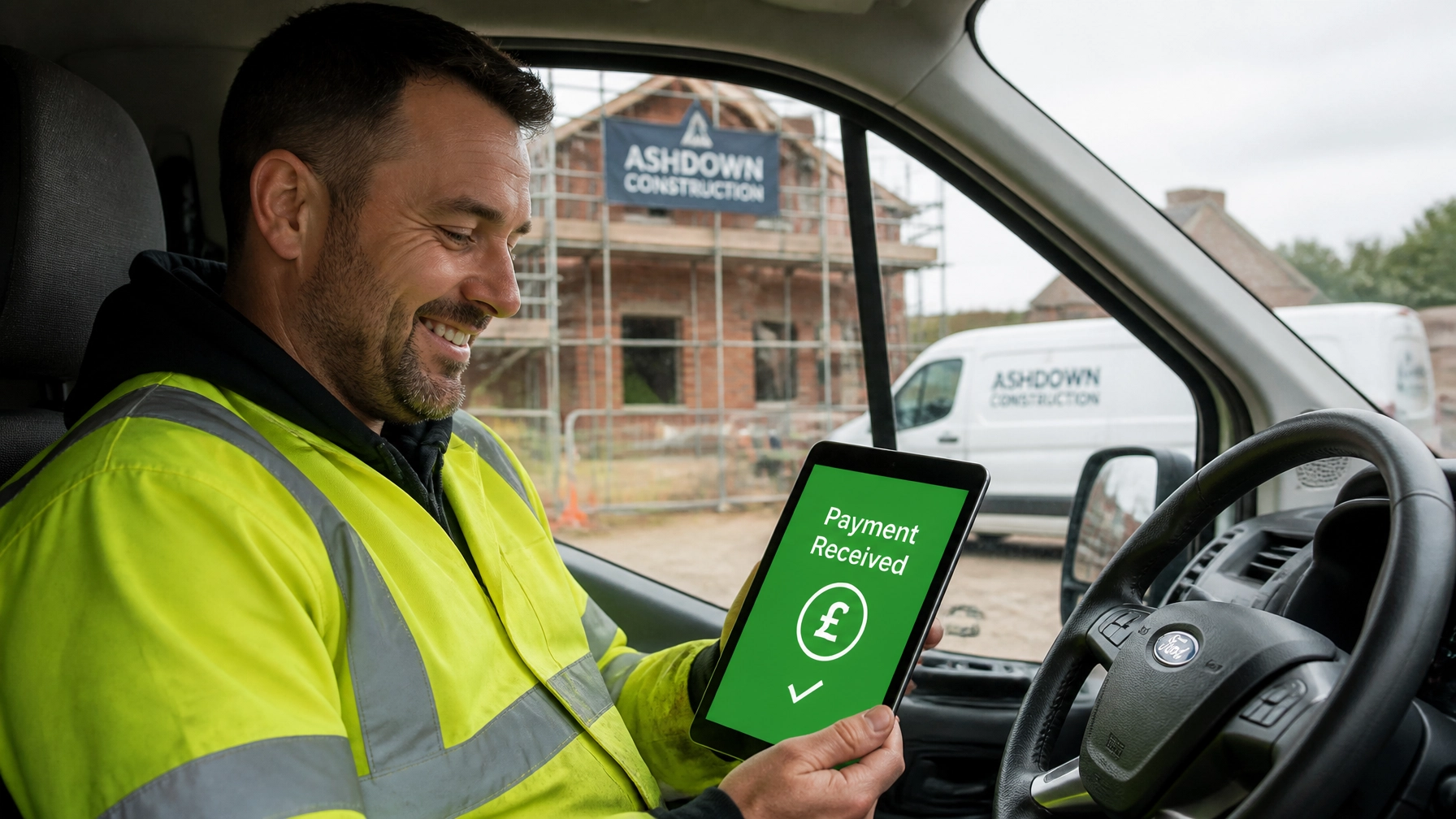
Let’s be honest: nobody goes into the construction trade because they love chasing invoices. You started your business to build, install, or renovate, not to spend your Friday nights acting as a debt collector for a contractor who "forgot" to process your payment.
Yet, for many UK small businesses and subcontractors, the "Bank of Me" is open 24/7. You pay for materials upfront, you pay your team (especially with the new 2026 minimum wage of £12.71 an hour biting into margins), and then you wait. And wait. And wait.
As an AAT Licensed Bookkeeping Practitioner, we see this daily at SBS Essex Ltd. We know that cash flow isn’t just a line on a spreadsheet, it’s the fuel that keeps your van on the road and your mortgage paid.
It’s time to stop being the "nice guy" and start being the "business guy." Here is our no-nonsense guide to turning the tables on late payers and getting your hard-earned cash back where it belongs: in your bank account.
1. Stop the Rot Before It Starts: The Contract
The biggest mistake we see? Starting a job on a "handshake" or a vague email. If you don't have clear payment terms, you’re essentially giving your clients permission to pay you whenever they feel like it.
In 2026, with the government tightening rules via the Small Business Protections Bill, the standard expectation is becoming a 60-day maximum cap, but for a small business, 30 days, or even 14, should be your aim.
Action Plan:
- Be Clear: State your payment terms on every single quote and invoice.
- Due Dates: Don’t just say "Payment in 30 days." Give a specific date: “Payment Due: 25th June 2026.”
- The "Construction Act" Clause: If you are working on a larger site, ensure you know your rights regarding "Pay Less" notices. If they haven't sent you a valid notice, they generally have to pay the full amount of your application.
2. Automate the "Chasing" (So You Don't Have To)
One of the reasons builders hate chasing money is that it feels awkward. You don't want to ruin a relationship with a contractor you might work with again next month.
This is where software like Sage, Xero, or FreeAgent becomes your best friend. Instead of you calling up and sounding stressed, the software sends a polite, professional automated reminder. It’s not personal; it’s just the system.

At SBS Essex, we help our clients set up these workflows. We find that a "7 days before due date" friendly nudge, followed by a "1 day overdue" reminder, can speed up payments by over 40%. If you aren't sure which tool fits your trade, we offer a free 1-hour discovery consultation to help you choose.
3. The Secret Weapon: Statutory Interest
Did you know that UK law gives you a legal right to charge interest on late B2B payments? It’s called Statutory Interest, and in 2026, it is one of the most under-utilised tools in a subcontractor's belt.
The rate is 8% plus the Bank of England base rate. If the base rate is 5%, you can charge a whopping 13% annual interest, calculated daily, from the moment the invoice becomes overdue.
But wait, there’s more. You can also charge a fixed debt recovery fee for every single invoice that goes late:
- £40 for debts up to £999.99
- £70 for debts between £1,000 and £9,999.99
- £100 for debts of £10,000 or more
Pro Tip: You don't even need to have this in your contract, it’s a statutory right under the Late Payment of Commercial Debts (Interest) Act 1998. Simply adding a line to your invoice saying, "We reserve the right to charge interest and compensation for late payment under the Late Payment of Commercial Debts Act," is often enough to move your invoice to the top of their "to-pay" pile.
4. The CIS Factor: Don't Get Caught Out
For those in the construction industry, late payments are complicated by the Construction Industry Scheme (CIS).
When a contractor pays you late, they still have to make the correct CIS deductions. When you calculate your interest and compensation, you should generally calculate it based on the net amount they owe you (the bit that actually hits your bank account).
Managing this manually is a headache, which is why expert CIS management is one of our most popular services. We ensure your verifications are correct, your deductions are spot on, and your interest calculations (if you choose to levy them) are legally sound.

5. Use the "Good Cop, Bad Cop" Strategy
Sometimes, the client just needs to see a different name in their inbox. If you’ve sent three reminders and you’re still being ignored, it’s time to escalate.
This doesn't always mean a solicitor. Often, having your Bookkeeping Practitioner send a formal "Statement of Account" or a "Letter Before Action" is enough to show you mean business. It takes the emotion out of it and signals that your financial management is handled by professionals who aren't going to let a £5,000 debt slide.
At SBS Essex, we act as that professional buffer. We handle the reconciliations, the tailored reports, and the awkward follow-ups, so you can stay on-site doing what you do best.
Why 2026 is the Year to Get Tough
With Making Tax Digital (MTD) for Income Tax now fully rolled out as of April 2026, the days of "sorting the shoebox" at the end of the year are gone. You need real-time data. If your books are a mess because half your invoices are "sort of paid" or "pending," you’ll struggle to stay compliant with HMRC.
Clean books aren't just for the taxman; they are your best defence against late payers. When you can see at a glance exactly who owes what, and for how long, you stop losing money through the cracks.

Let’s Get You Paid
You work hard for your money. You shouldn't have to work twice as hard to actually get it. Whether you need a one-off cleanup of your ledger or ongoing Virtual Assistant support to handle your admin, we’re here to help.
Ready to reclaim your Friday nights?
Let’s chat. We offer a free 1-hour discovery consultation to look at your current processes and see how we can make your business more efficient, more profitable, and, most importantly, compliant.
Book Your Free Consultation with SBS Essex Today
Frequently Asked Questions
Can I charge interest on an invoice from six months ago?
Yes. You can claim interest and compensation on invoices that were paid late up to six years ago, provided you haven't waived your right to do so in a signed agreement.
What if my client says they can't pay because their own client hasn't paid them?
In the UK, "pay-when-paid" clauses are generally illegal in construction contracts. Their obligation to pay you is independent of their own cash flow issues.
Does charging interest ruin client relationships?
It’s a business decision. However, many of our clients find that once they implement a clear "Late Payment Policy," the serial late payers either start paying on time or stop wasting your time, leaving room for better clients who value your work.
Which software is best for construction?
We find that Xero and Sage both offer fantastic CIS modules that make tracking retentions and deductions much simpler than manual spreadsheets.